Book Wisdom
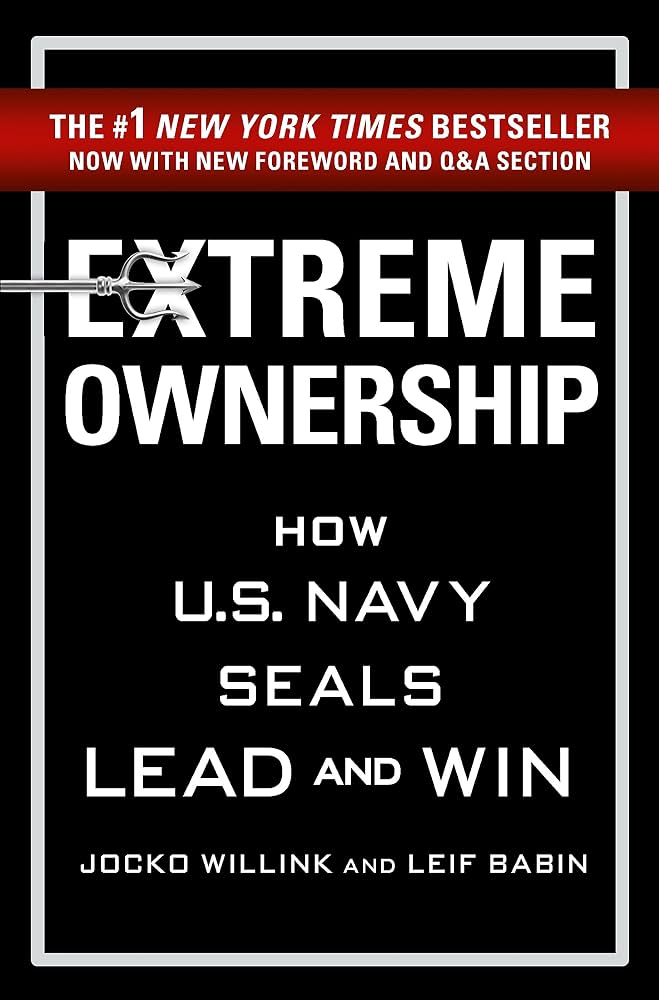
Extreme Ownership
How U.S. Navy SEALs Lead and Win
Jocko Willink and Leif Babin
Two SEAL task unit leaders who fought in Ramadi, Iraq turn hard battlefield lessons into a leadership playbook. The core idea is simple and uncomfortable: everything that goes wrong in your world is yours to fix, so stop looking for someone to blame and start looking at what you can change.
Top 10 insights
- 1
Own everything
Take total responsibility for every result in your world. No excuses, no blaming others. When something fails, ask what you could have done differently.
- 2
No bad teams, only bad leaders
If a team is struggling, look at the leader first. Standards, training, and clarity all start at the top. Change the leadership and the same people perform differently.
- 3
Believe in the mission
You cannot inspire people to follow a mission you do not believe in yourself. Keep asking questions up the chain until you understand the why, then pass it on.
- 4
Check your ego
Ego clouds judgment, blocks honest self-assessment, and hides mistakes. Put the mission ahead of being right and you learn faster than everyone else.
- 5
Cover and move
Every team and department exists to support the others. Break down silos and help the group next to you, because the win belongs to the whole team.
- 6
Keep plans simple
Complicated plans fall apart under pressure. Brief it so the most junior person can explain it back, and ask the team directly if they understand.
- 7
Prioritize and execute
When everything hits at once, step back and pick the single most important problem. Say it out loud, put your resources on it, then move to the next one.
- 8
Decentralize command
Nobody can manage dozens of people directly. Split into small teams, explain the intent clearly, and let leaders make decisions within clear boundaries.
- 9
Lead up and down the chain
Your job includes your boss. If you are not getting what you need, do not complain; communicate, educate, and show them why. Do the same for the people under you.
- 10
Act decisively amid uncertainty
You will never have perfect information. Make the best call with what you know, then adjust as new facts arrive. Waiting for certainty is a decision to lose.
Stories that teach the book
The three moments that carry the most important lessons.
Story 1 · Ramadi, Iraq
The friendly fire incident
During a chaotic operation, a breakdown in coordination led to a firefight between friendly forces. An Iraqi soldier was killed and others were wounded. In the debrief that followed, there were plenty of places to point: the confusing urban terrain, other units, the fog of war.
Principle
Extreme Ownership
Takeaway
Jocko, the task unit commander, refused every excuse. He told his leaders the failure was his, named what he should have done differently, and committed to fixing it. Owning it fully kept the trust of his team and his chain of command, and made the unit better.
Story 2 · BUD/S Hell Week
The boat crew swap
In SEAL training, boat crews race while carrying a heavy inflatable boat. One crew kept finishing last while another kept winning. The easy explanation was that the losing crew was weaker, and that crew's leader said so. Instructors decided to test it by swapping the two leaders.
Principle
No bad teams, only bad leaders
Takeaway
With the same people in the boat, the struggling crew started winning under its new leader. The difference was never the team. It was how the leader set the standard, handled setbacks, and treated the crew.
Story 3 · Ramadi, Iraq
The overly complex plan
Leif built a detailed, multi-layered plan for a dangerous operation. It made sense to him, but when he briefed the subordinate leaders, it was clear they were confused. A plan that is brilliant on paper but not understood by the people carrying it out is a plan that fails.
Principle
Keep plans simple and decentralize command
Takeaway
If the team cannot explain the plan back, it is too complicated. Simplify it, confirm everyone understands their role and the intent, then trust them to make decisions in the moment.
Want the full story?